
| The Big Picture |
JEFFREY PALLADINI: THE BIG PICTURE
By Peter Frank
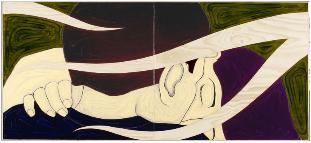
Jeffrey Palladini professes to, and clearly practices, a painterly formalism in which line and texture describe
movements and patterns on sturdy but absorbent surfaces. Compositional dynamics play within the picture
and in the determination of its perimeter. “Independence from the stretched canvas,” writes Palladini,
regarding his use of wood panel as support, “leads me to work with irregular shapes, to cut contours, to
pierce the surface plane.” For all this, however, Palladini is no abstractionist. His work displays a
thoroughly evident subject matter, as unmistakable as a billboard’s – or, perhaps better said, as a film
projection’s.
Palladini’s pictorial vocabulary would once have been labeled Pop, and would have been considered for its
relation to billboards and movie screens and other support structures associated with popular culture, as
well as for its stark figure-ground contrasts. But Pop imagery has itself become so ubiquitous – to the
extent where it has reshaped the very pop culture that shaped it – that we know now to look deeper, to
regard Palladini’s pictures as something more than neo-Pop. They do not merely reconsider the post-
modern feedback mechanism of Pop art and pop culture, but harness that richly associative mechanism to
the purposes of narrative – or, at least, narrative incident and atmosphere.
Even without the distancing quality the decorous patterned overlays so often lend his paintings (but
especially with that quality), Palladini seeks to convey a stylized, even theatricalized acting-out of intense
human emotion. Anger, pain, lust, fear, reverie, regret, and a host of other emotions and emotional states
play across his pictures, in effect enacted by the one or more human beings present therein. Interestingly,
Palladini almost never relies on the faces of his men or women to convey these passions, even when those
visages – the usual repositories of expression – are in full view. Instead, he sets in motion fleeting scenes
whose overall coherence bespeaks the range of human experience: pairs embracing tenderly or hungrily,
the rhythmic tensions of small groups, the spark of anticipation or weight of worry raising or lowering a man’
s back. And, in good cinematic fashion, Palladini renders these raw, basic choreographies in close-up, so
that the viewer is afforded little sensate distance.
You would be forgiven were you to think that Palladini were quoting or paraphrasing frames from a film noir
classic or nouvelle vague landmark. Instead, of course, he is “shooting” his own movies – or, rather,
shooting into cinematic conventions, bringing their emotional truths and manipulations to the surface,
freezing them onto obdurate panels, and allowing them – now given both depth and gloss by their
painterliness – to move us without benefit of story line. Palladini does not bring us to these climactic
scenes and Greek choruses through any narrative arc; if anything, he reverses such a process, positing
singular incidents from which we might devolve the narratives that led to them. Even so, the paintings are
no mere film stills, but, again, renditions of human actions made visually – and thus emotionally – vibrant
with pigment, hand-drawn line, and judicious suppression of background detail.
That suppression, pointing stylistically at the cool middle-distance of Pop art, in fact is a powerful way of
stimulating our empathic comprehension. By keeping his figures stark and his backgrounds free of
distraction, Palladini allows us a great deal of latitude in interpreting the apparent goings-on – actually, in
formulating our own narratives. The close spatial proximity we feel to the protagonists prompts our
involvement and our belief that we know reasonably well what’s going on and perhaps even what motivates
the women and men we see. Their motivations and even identities might remain mysterious, but their
behavior and their feelings in and around the moments we witness seem at least somewhat self-evident.
Sex is sex, after all, loneliness is loneliness, sorrow is sorrow.
Or is it? Just because a man’s shoulders and a woman’s are bare at the time of their embrace does not
guarantee that such contact is erotic. Just because a fellow raises his hands to the back of his head does
not mean he’s feeling pain. The proximity of water, for instance, may be prompting people’s actions or
dress; so might heat or nightfall or a hospital interior. The patterns Palladini frequently etches onto his
images tend if anything to draw us away from the certainty of our initial conclusions; they tempt and finally
resist interpretation, and yet they insist on encumbering our search for story. Just as the backs of people’s
heads are in far greater evidence in this body of work than are their faces, embraces are common here
but actual liplocks occur rarely. These and other devices and situations – camera angles, if you will –
deflect the certainty of our interpretation but only redouble the intensity of our gaze. Our curiosity, not
sufficiently fulfilled, keeps us riveted, as if something else might happen in each painting.
Not only does nothing else happen in any one painting (for all their resemblance to certain types of
cartoon, Palladini has not – so far at least – broken up his panels into comic strip frames), nothing
sequential happens between paintings. At most, two paintings might seem to share the same players, but
not the same events. Palladini forces us to experience his pictures as stand-alone phenomena, moments
frozen not only in time and space, but in sense. At the same time, his painterly treatment keeps them partly
“un-frozen,” resistant – however stylized they may appear – to iconization; their linear suppleness, their
sensuous surface, and their peculiar palette keep Palladini’s paintings as unsettled as they are static.
They nearly move, just as they nearly mean – but they don’t move, and they mean only what you want and
hope them to mean.
To his cinema in paint, Jeffrey Palladini brings only a cast and various mises en scène. The rest is up to
you. “The viewer,” Marcel Duchamp opined, “completes the work of art.” We complete Palladini’s art by
allowing it to play out not just in front of our eyes, but in our minds, where its Pop-like superficiality is
revealed as a false front, a conceptual glaze that challenges our entry. There is more in Palladini’s
painting than meets the eye; how much more depends on the eye.
Los Angeles
December 2006
By Peter Frank
Jeffrey Palladini professes to, and clearly practices, a painterly formalism in which line and texture describe
movements and patterns on sturdy but absorbent surfaces. Compositional dynamics play within the picture
and in the determination of its perimeter. “Independence from the stretched canvas,” writes Palladini,
regarding his use of wood panel as support, “leads me to work with irregular shapes, to cut contours, to
pierce the surface plane.” For all this, however, Palladini is no abstractionist. His work displays a
thoroughly evident subject matter, as unmistakable as a billboard’s – or, perhaps better said, as a film
projection’s.
Palladini’s pictorial vocabulary would once have been labeled Pop, and would have been considered for its
relation to billboards and movie screens and other support structures associated with popular culture, as
well as for its stark figure-ground contrasts. But Pop imagery has itself become so ubiquitous – to the
extent where it has reshaped the very pop culture that shaped it – that we know now to look deeper, to
regard Palladini’s pictures as something more than neo-Pop. They do not merely reconsider the post-
modern feedback mechanism of Pop art and pop culture, but harness that richly associative mechanism to
the purposes of narrative – or, at least, narrative incident and atmosphere.
Even without the distancing quality the decorous patterned overlays so often lend his paintings (but
especially with that quality), Palladini seeks to convey a stylized, even theatricalized acting-out of intense
human emotion. Anger, pain, lust, fear, reverie, regret, and a host of other emotions and emotional states
play across his pictures, in effect enacted by the one or more human beings present therein. Interestingly,
Palladini almost never relies on the faces of his men or women to convey these passions, even when those
visages – the usual repositories of expression – are in full view. Instead, he sets in motion fleeting scenes
whose overall coherence bespeaks the range of human experience: pairs embracing tenderly or hungrily,
the rhythmic tensions of small groups, the spark of anticipation or weight of worry raising or lowering a man’
s back. And, in good cinematic fashion, Palladini renders these raw, basic choreographies in close-up, so
that the viewer is afforded little sensate distance.
You would be forgiven were you to think that Palladini were quoting or paraphrasing frames from a film noir
classic or nouvelle vague landmark. Instead, of course, he is “shooting” his own movies – or, rather,
shooting into cinematic conventions, bringing their emotional truths and manipulations to the surface,
freezing them onto obdurate panels, and allowing them – now given both depth and gloss by their
painterliness – to move us without benefit of story line. Palladini does not bring us to these climactic
scenes and Greek choruses through any narrative arc; if anything, he reverses such a process, positing
singular incidents from which we might devolve the narratives that led to them. Even so, the paintings are
no mere film stills, but, again, renditions of human actions made visually – and thus emotionally – vibrant
with pigment, hand-drawn line, and judicious suppression of background detail.
That suppression, pointing stylistically at the cool middle-distance of Pop art, in fact is a powerful way of
stimulating our empathic comprehension. By keeping his figures stark and his backgrounds free of
distraction, Palladini allows us a great deal of latitude in interpreting the apparent goings-on – actually, in
formulating our own narratives. The close spatial proximity we feel to the protagonists prompts our
involvement and our belief that we know reasonably well what’s going on and perhaps even what motivates
the women and men we see. Their motivations and even identities might remain mysterious, but their
behavior and their feelings in and around the moments we witness seem at least somewhat self-evident.
Sex is sex, after all, loneliness is loneliness, sorrow is sorrow.
Or is it? Just because a man’s shoulders and a woman’s are bare at the time of their embrace does not
guarantee that such contact is erotic. Just because a fellow raises his hands to the back of his head does
not mean he’s feeling pain. The proximity of water, for instance, may be prompting people’s actions or
dress; so might heat or nightfall or a hospital interior. The patterns Palladini frequently etches onto his
images tend if anything to draw us away from the certainty of our initial conclusions; they tempt and finally
resist interpretation, and yet they insist on encumbering our search for story. Just as the backs of people’s
heads are in far greater evidence in this body of work than are their faces, embraces are common here
but actual liplocks occur rarely. These and other devices and situations – camera angles, if you will –
deflect the certainty of our interpretation but only redouble the intensity of our gaze. Our curiosity, not
sufficiently fulfilled, keeps us riveted, as if something else might happen in each painting.
Not only does nothing else happen in any one painting (for all their resemblance to certain types of
cartoon, Palladini has not – so far at least – broken up his panels into comic strip frames), nothing
sequential happens between paintings. At most, two paintings might seem to share the same players, but
not the same events. Palladini forces us to experience his pictures as stand-alone phenomena, moments
frozen not only in time and space, but in sense. At the same time, his painterly treatment keeps them partly
“un-frozen,” resistant – however stylized they may appear – to iconization; their linear suppleness, their
sensuous surface, and their peculiar palette keep Palladini’s paintings as unsettled as they are static.
They nearly move, just as they nearly mean – but they don’t move, and they mean only what you want and
hope them to mean.
To his cinema in paint, Jeffrey Palladini brings only a cast and various mises en scène. The rest is up to
you. “The viewer,” Marcel Duchamp opined, “completes the work of art.” We complete Palladini’s art by
allowing it to play out not just in front of our eyes, but in our minds, where its Pop-like superficiality is
revealed as a false front, a conceptual glaze that challenges our entry. There is more in Palladini’s
painting than meets the eye; how much more depends on the eye.
Los Angeles
December 2006
