| Artist Statements |
Not Even Past
[Written for "Not Even Past", a solo exhibition at Mika Contemporary Art, TelAviv,
Israel, January, 2015]
This body of work wrestles with our relationship to time, both in its immutable progression
and in its plasticity. Regardless of our endless efforts to thwart it, save it, slow it down, we
are helpless in the face of time’s steady march. Many of these works embody this
concept through the repetition of figures, signifying sequential moments. I have, however,
also become increasingly fascinated with theories of the multiplicity of time. Perhaps
moments are not linear and sequential, but looping, repeating, simultaneous. William
Faulkner, in the famous line from Requiem for a Nun, writes, “The past is never dead.
Actually, it is not even past.” Perhaps past and future are always with us, ever-present.
This idea, this question, this contradiction, is the conceptual underpinning of these works.
Subtraction
[Written for "Subtraction", a solo exhibition at Gallery IMA, Seattle, November, 2010]
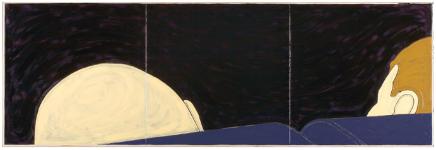
Rather than building up story elements to build narrative, in these works I seek to subtract. The
fictional arc is the starting point, and details are progressively removed. Narrative is boiled down,
reduced, distilled. Background details are suppressed, with little indication of setting. Faces
averted, the figures themselves seek anonymity. In some cases, even sections of paint have been
omitted. And yet, even with such scant information provided, and perhaps because of it, the
images are highly charged and rich with possibility. The viewer is willingly recruited to supply
details from their own perspectives, their own experiences – to begin the process of building the
story anew.
Why No Faces?
[This statement was created for my summer 2010 solo exhibition "Recent Work: Jeffrey Palladini"
at Sandra Lee Gallery in San Francisco. During the opening reception, Sandra and I were both
asked repeatedly about the prevalence of averted faces in the paintings in the show. I decided it
was high time to address the issue]
The greatest benefit, from the artist’s standpoint, to making figurative art is also its greatest
challenge – which is that the human figure demands immediate connection with the viewer. It is
impossible to look an image of the human form and not automatically search for narrative. This is
generally advantageous, but it can also be a negative, and here’s why: Figures, and most
especially the faces, inspire people to involuntarily and reflexively seek recognition – it’s an
instinctive and ancestral function of the brain. Who is this? Friend or foe? Potential mate? With
faces evident, the viewer is likely to make connections they can’t get past: “this one looks like my
ex-girlfriend,” or “Hey, that reminds me of my Dad”. I feel that this kind of recognition inhibits, or at
very least colors, the viewer’s ability to delve into the implied narrative on their own terms.
By employing the quarter-view of the face in these works, I draw the viewer into the painting – they
feel that instinctive need to know who the figure is, what he’s looking at, what’s the setting. There
is a vast world of action, setting, story, and other characters just out of view, and the viewer is
compelled to seek it out. I include minimal visual information and do my best to charge the image
with emotional tension. In this way, the viewers build the narrative for themselves by joining their
own points of view, prejudices, desires, fears, and histories to the scant information that I provide.
An Endless Succession of Moments / The Vast Remainder
[Written for solo exhibitions "An Endless Succession of Moments" at Gallery IMA, Seattle, April
2009, and "The Vast Remainder" at Sam the Butcher Contemporary Art, Ross, CA, September
2009]
In these paintings are captured, in bright, brief flashes, complex emotion and intense intimacy.
With minimal visual information provided, to the viewer is left the imperative of exploring the vast
remainder. From a movie still is extrapolated a full film of character, pacing, plot and script. From
a paragraph, an entire novel. From a brief encounter, a lifetime of histories and potentialities.
From a single windowpane spreads a wide, complicated landscape. From one charged moment,
the story extends infinitely in all directions.
As in memory, all is viewed in snapshots, in glimpses. Complex narratives, transformative events,
entire lifetimes, boiled down to these singular points in time.
The Fundamental Forces
[Created for my 2007 solo exhibition "The Fundamental Forces" at Crome Architecture in San
Rafael, CA. This idea has been the conceptual seed for a number of works since 2006, including
the entire Scatter Series of paintings]
We go through our lives acting on our assumption of free will, while all the while being bombarded
with influence from other internal and external forces. Often, our personal stimuli - memories,
inspiration, longing, lust - seem to come from somewhere outside ourselves, outside our control.
Even our dreams are involuntary and untethered. The passage of time and tug of gravity on our
fragile physical selves weigh heavy and infuse our most optimistic and hopeful endeavors with the
faint tang of futility and temporality. Any effort, toward outcomes both positive and negative,
depends more than we care to admit on the cooperation of unknown strangers, indifferent physics,
and the arbitrary nature of chance.
Works on Wood
[This statement was written to address repeated questions early in my career about my technique.
Artists across many cultures over many centuries have used wood grounds in their paintings, but
the importance of the wood in my work has generated much interest to this day]
Wood, I have found, is an ideal partner to oil paint. Because the wood is porous and absorbent,
with inherent grain and flaws, it alternately resists and drinks in the oil medium. This creates the
most wonderful and unpredictable effects. The grain adds depth and texture behind flat blocks of
translucent color. The wood always asserts itself in some way, regardless of the treatment of the
image or the density of paint application. I often leave fields of unaltered wood in the work - a dry,
natural section that provides an interesting contrast to the slick feel of the painted areas.
The use of wood in my work has also allowed me to break out of the flat rectangle. Independence
from the stretched canvas leads me to work with irregular shapes, to cut contours, to pierce the
surface plane. Emotionally, works on wood give the feeling of permanence, of weight and solidity,
of the painting as object. My work explores the relationship between this structural, architectural
ground, and the organic, plastic qualities of the medium and image.
Pattern Elements
[Written for one of my first solo exhibitions at the Lowe Gallery in Santa Monica in 2004]
The pattern elements in my work serve as a sort of undercurrent. The metaphorical, the
metaphysical. The subliminal, the subconscious. The passage of time, unspoken connections, a
sense of place. With the comparatively concrete elements, like figure, the combination produces
an interesting duality: the visual equivalent of the said and the unsaid, text and subtext.
Eroticism
[Created in the wake of numerous questions arising out of a solo exhibition at the Lowe Gallery in
Santa Monica in 2005]
Much of my work brandishes a sort of ambiguous eroticism – a vaguely (and sometimes not-so-
vaguely) sexual tension that shows through even the most neutral imagery. The multiple figures
which populate many of my recent works share narratives that are compelling but not quite overt,
encouraging the viewer to project their own stories and points of view into their interpretations.
[Written for "Not Even Past", a solo exhibition at Mika Contemporary Art, TelAviv,
Israel, January, 2015]
This body of work wrestles with our relationship to time, both in its immutable progression
and in its plasticity. Regardless of our endless efforts to thwart it, save it, slow it down, we
are helpless in the face of time’s steady march. Many of these works embody this
concept through the repetition of figures, signifying sequential moments. I have, however,
also become increasingly fascinated with theories of the multiplicity of time. Perhaps
moments are not linear and sequential, but looping, repeating, simultaneous. William
Faulkner, in the famous line from Requiem for a Nun, writes, “The past is never dead.
Actually, it is not even past.” Perhaps past and future are always with us, ever-present.
This idea, this question, this contradiction, is the conceptual underpinning of these works.
Subtraction
[Written for "Subtraction", a solo exhibition at Gallery IMA, Seattle, November, 2010]
Rather than building up story elements to build narrative, in these works I seek to subtract. The
fictional arc is the starting point, and details are progressively removed. Narrative is boiled down,
reduced, distilled. Background details are suppressed, with little indication of setting. Faces
averted, the figures themselves seek anonymity. In some cases, even sections of paint have been
omitted. And yet, even with such scant information provided, and perhaps because of it, the
images are highly charged and rich with possibility. The viewer is willingly recruited to supply
details from their own perspectives, their own experiences – to begin the process of building the
story anew.
Why No Faces?
[This statement was created for my summer 2010 solo exhibition "Recent Work: Jeffrey Palladini"
at Sandra Lee Gallery in San Francisco. During the opening reception, Sandra and I were both
asked repeatedly about the prevalence of averted faces in the paintings in the show. I decided it
was high time to address the issue]
The greatest benefit, from the artist’s standpoint, to making figurative art is also its greatest
challenge – which is that the human figure demands immediate connection with the viewer. It is
impossible to look an image of the human form and not automatically search for narrative. This is
generally advantageous, but it can also be a negative, and here’s why: Figures, and most
especially the faces, inspire people to involuntarily and reflexively seek recognition – it’s an
instinctive and ancestral function of the brain. Who is this? Friend or foe? Potential mate? With
faces evident, the viewer is likely to make connections they can’t get past: “this one looks like my
ex-girlfriend,” or “Hey, that reminds me of my Dad”. I feel that this kind of recognition inhibits, or at
very least colors, the viewer’s ability to delve into the implied narrative on their own terms.
By employing the quarter-view of the face in these works, I draw the viewer into the painting – they
feel that instinctive need to know who the figure is, what he’s looking at, what’s the setting. There
is a vast world of action, setting, story, and other characters just out of view, and the viewer is
compelled to seek it out. I include minimal visual information and do my best to charge the image
with emotional tension. In this way, the viewers build the narrative for themselves by joining their
own points of view, prejudices, desires, fears, and histories to the scant information that I provide.
An Endless Succession of Moments / The Vast Remainder
[Written for solo exhibitions "An Endless Succession of Moments" at Gallery IMA, Seattle, April
2009, and "The Vast Remainder" at Sam the Butcher Contemporary Art, Ross, CA, September
2009]
In these paintings are captured, in bright, brief flashes, complex emotion and intense intimacy.
With minimal visual information provided, to the viewer is left the imperative of exploring the vast
remainder. From a movie still is extrapolated a full film of character, pacing, plot and script. From
a paragraph, an entire novel. From a brief encounter, a lifetime of histories and potentialities.
From a single windowpane spreads a wide, complicated landscape. From one charged moment,
the story extends infinitely in all directions.
As in memory, all is viewed in snapshots, in glimpses. Complex narratives, transformative events,
entire lifetimes, boiled down to these singular points in time.
The Fundamental Forces
[Created for my 2007 solo exhibition "The Fundamental Forces" at Crome Architecture in San
Rafael, CA. This idea has been the conceptual seed for a number of works since 2006, including
the entire Scatter Series of paintings]
We go through our lives acting on our assumption of free will, while all the while being bombarded
with influence from other internal and external forces. Often, our personal stimuli - memories,
inspiration, longing, lust - seem to come from somewhere outside ourselves, outside our control.
Even our dreams are involuntary and untethered. The passage of time and tug of gravity on our
fragile physical selves weigh heavy and infuse our most optimistic and hopeful endeavors with the
faint tang of futility and temporality. Any effort, toward outcomes both positive and negative,
depends more than we care to admit on the cooperation of unknown strangers, indifferent physics,
and the arbitrary nature of chance.
Works on Wood
[This statement was written to address repeated questions early in my career about my technique.
Artists across many cultures over many centuries have used wood grounds in their paintings, but
the importance of the wood in my work has generated much interest to this day]
Wood, I have found, is an ideal partner to oil paint. Because the wood is porous and absorbent,
with inherent grain and flaws, it alternately resists and drinks in the oil medium. This creates the
most wonderful and unpredictable effects. The grain adds depth and texture behind flat blocks of
translucent color. The wood always asserts itself in some way, regardless of the treatment of the
image or the density of paint application. I often leave fields of unaltered wood in the work - a dry,
natural section that provides an interesting contrast to the slick feel of the painted areas.
The use of wood in my work has also allowed me to break out of the flat rectangle. Independence
from the stretched canvas leads me to work with irregular shapes, to cut contours, to pierce the
surface plane. Emotionally, works on wood give the feeling of permanence, of weight and solidity,
of the painting as object. My work explores the relationship between this structural, architectural
ground, and the organic, plastic qualities of the medium and image.
Pattern Elements
[Written for one of my first solo exhibitions at the Lowe Gallery in Santa Monica in 2004]
The pattern elements in my work serve as a sort of undercurrent. The metaphorical, the
metaphysical. The subliminal, the subconscious. The passage of time, unspoken connections, a
sense of place. With the comparatively concrete elements, like figure, the combination produces
an interesting duality: the visual equivalent of the said and the unsaid, text and subtext.
Eroticism
[Created in the wake of numerous questions arising out of a solo exhibition at the Lowe Gallery in
Santa Monica in 2005]
Much of my work brandishes a sort of ambiguous eroticism – a vaguely (and sometimes not-so-
vaguely) sexual tension that shows through even the most neutral imagery. The multiple figures
which populate many of my recent works share narratives that are compelling but not quite overt,
encouraging the viewer to project their own stories and points of view into their interpretations.
